
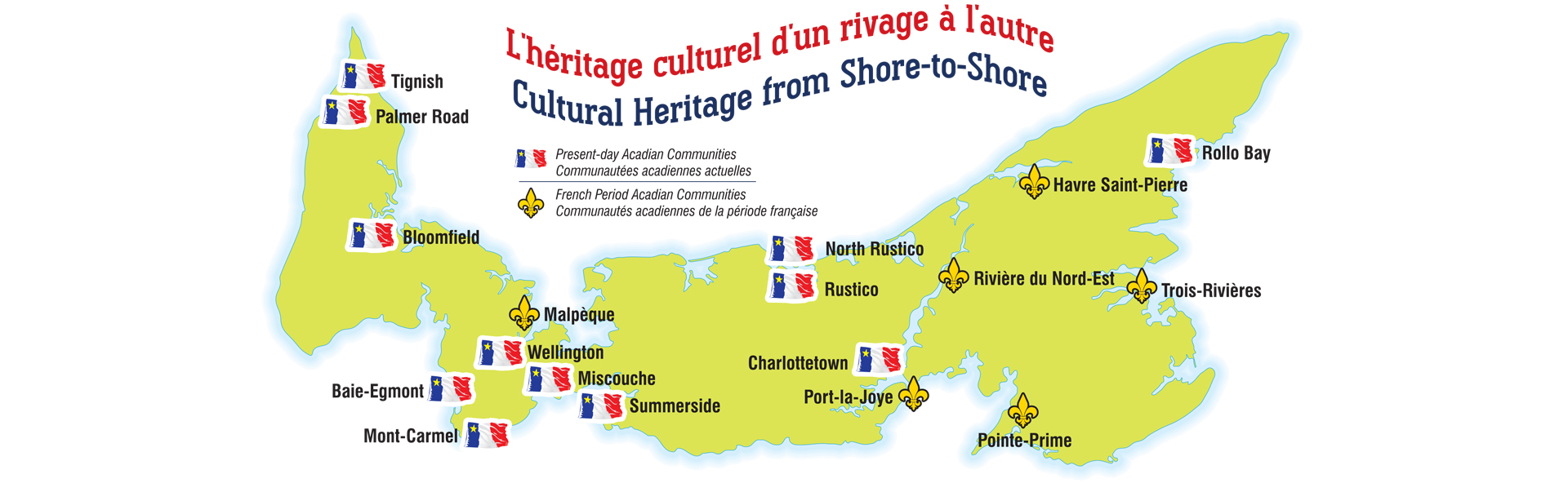
The Exploring Acadian Communities Past and Present map presents a self-guided itinerary of the 18 most noteworthy Acadian heritage places on Prince Edward Island. The map is accompanied by a total of 18 articles, all corresponding to the map, describing why each is significant (authored by Prince Edward Island Acadian scholar Georges Arsenault).
Tignish
The village of Tignish is the centre of a large Catholic parish comprising fifteen villages established at the turn of the 19th century by Acadian and Irish families. Although the first inhabitants were mainly farmers, the fishing industry took off in the 1840s and eventually became the main source of livelihood for a large part of the population. Among the descendants of Tignish’s first Acadian families are Father Sylvain-Éphrem Perrey (Poirier), the first Maritime Acadian to be received into the priesthood, and his nephew Stanislaus Perry, the first Acadian politician from Prince Edward Island and the first Maritime Acadian to be elected to the Canadian Parliament. It was also in Tignish that L’Impartial, the Island’s first French-language newspaper, was published by the Buote family from 1893 to 1915.
Palmer Road
Palmer Road is a small community at the centre of a sprawling territory also known as Palmer Road. It encompasses the Catholic parish of Palmer Road, which includes several Acadian and Irish districts. These include St. Louis, St. Edward, Peterville, Leoville, Deblois, St. Lawrence, Miminegash, Ebbsfleet, Pleasant View, Waterford, Skinner’s Pond, Palmer Road North, Palmer Road South and, of course, Palmer Road. The first Acadian inhabitants of these villages came from the neighboring region of Tignish. Over the years, a number of Acadian families from New Brunswick also settled here. Beginning in the 1820s, a large number of Irish arrived and settled near the sea in Skinner’s Pond, Waterford and Miminegash. Originally a mission of the parish of Tignish, it wasn’t until 1878 that the parish of Palmer Road was created under the name Immaculate Conception.
Bloomfield Parish
The parish of Bloomfield includes many Acadian families living in eight villages, namely Bloomfield, Bloomfield Corner, Woodstock, Fortune Cove, Piusville, Roxbury, Howlan and Duvar. The first Acadians arrived in the region in 1801 from Malpeque Bay. They settled in Cascumpec on the bay of the same name. But eventually, as the population grew, descendants of the founding families and new arrivals settled along the banks of the Hill, Trout and Foxley rivers, and inland at Bloomfield. In 1873, to better serve the entire parish, a new church was built in a more central location, in Bloomfield. At this time, many Acadian families from Rustico came to take up land in the area, notably in Duvar, Howlan and Piusville, to establish themselves as farmers.
Baie-Egmont
The Acadian parish of Egmont Bay was founded in 1812. Its first inhabitants came from Malpeque Bay, where they rented their farms from a large landowner. In Egmont Bay, which they called La Roche, they became landowners. These pioneers included Arsenaults, Bernards, Cormiers and Gallants. The parish includes eight villages, each with its own school until the 1960s. Of these, the most populous are Abram-Village, Urbainville, and Saint-Chrysostome. Among the most notable figures to emerge from the parish were merchant and politician Joseph-Octave Arsenault, who became the province’s first Acadian senator; lawyer and politician Aubin-Edmond Arsenault, who became the first Acadian to head a Canadian province; and Angèle Arsenault, a nationally-renowned singer.
Mont Carmel
The founding families of Notre-Dame-du-Mont-Carmel parish were the Arsenaults, Aucoins, Downings, Gallants and Richards. The first families arrived in Mont-Carmel in 1812. They came from the head of Malpeque Bay, where they had cleared and farmed their land for 50 years as tenants. Relations had deteriorated with their landlord and English neighbors, so they decided to abandon their farms and start over in Lot 15, where they saw the possibility of becoming landowners. They in fact obtained occupancy permits in 1819 and the deeds in 1828. The parish of Mont-Carmel is made up of four villages: Mont-Carmel, Saint-Raphaël, Saint-Timothée and Cap-Egmont. During the pastorate of dynamic Father Pierre-Paul Arsenault (1896-1927), the parish, with some 135 families, acquired a magnificent church and an imposing brick presbytery designed by Quebec architect René P. Lemay. The site was also embellished with three fieldstone arches erected by local mason Cajétan Arsenault.
Wellington
The construction of a sawmill on the Ellis River in 1838 gave rise to the village of Wellington. At first, the site was known successively as Quagmire Mills, Campbell’s Mills and Barlow’s Mills. It wasn’t until 1874, when a railway station was built, that the site was officially named Wellington Station, because the station was located not far from the community of Wellington (now Wellington Centre). With the arrival of the railroad, the place, inhabited only by the Barlow family, owners of a sawmill, cardmill and flour mill, soon attracted business people who created jobs by establishing stores and other businesses. It was at this time that the first Acadian families arrived in Wellington. With its mills, stores and train station, the village became the region’s main commercial center. A school, a Protestant church, a hotel and a post office were soon to be built. It became an incorporated municipality in 1959. Located adjacent to the parishes of Egmont Bay and Mont-Carmel, Wellington attracted many Acadian families, so that today its population is predominantly of Acadian origin.
Miscouche
It is here in Miscouche that the Acadian flag was adopted in 1884 at the second National Acadian Convention. This convention brought together delegates from the Maritime provinces to discuss the advancement of the Acadian people and the preservation of their identity and culture. Miscouche had become a prosperous village with a convent-school of the Congregation de Notre-Dame de Montréal, opened in 1864, and a railway station erected in 1875. In 1884, the Summerside Journal described the community as a “beautiful country village (that) is currently in a prosperous and flourishing state. Our merchants have been exceedingly busy during the fall trade. Some were engaged in the produce trade, paying the highest prices in cash for potatoes, oats, etc. Others were engaged in the oyster trade, and others in the egg business. Besides merchants, we have quite a variety of mechanics, carriage builders, blacksmiths, tailors, shoemakers, carpenters, joiners, coopers, butchers, etc.”
Acadian Malpeque
It was in this area that in 1728 the first Acadian families to put down roots in the western half of the Island settled. These pioneers were members of the Arsenault family from Beaubassin, in Acadie. By 1752, this community was made up of 32 Acadian households with a population of 201 that lived mainly off the land. The settlement covered a large territory corresponding to the present villages of Bideford, Port Hill, Low Point and Birch Hill. The parish church was located at Low Point, a place that the Acadians later called Pointe-aux-Vieux. Although the Acadians were forced to abandon this area during the Deportation of 1758, the current population of the island includes a great many of their descendants.
Summerside
The city of Summerside grew up on the lands owned by the family of Daniel Green, a Quaker from Pennsylvania. He was a Loyalist who fled to the Island around 1785 during the American Revolution. For many years, Summerside was a small farming community called Greens Shore. But this changed in 1840 with the construction of a wharf called Queens Wharf. The town soon became a seaport from which agricultural products were exported. From 1850 onwards, however, it was the shipbuilding industry that contributed to the town’s growth. As the town grew, the population diversified with the arrival of many people of Scottish, Irish and French ethnic origins. The first generations of Acadians to move to Summerside were almost all members of the working class. Today, it is estimated that around 35% of Summerside’s population is either completely, or partly, of French ethnic origin.
North Rustico
The founding of North Rustico dates back to the 1790s, when several Acadian families settled here as tenants. Later, English, Scottish and Irish families joined them to build a community based on farming and fishing. A predominantly Catholic community belonging to the Rustico parish of Saint-Augustin, in 1936 it became an independent parish dedicated to the Virgin Mary under the name Stella Maris (Star of the Sea). The village of North Rustico, nicknamed La Crique, enjoyed a major economic revival in the 1930s and 1940s, thanks to the cooperative movement and the creation of Prince Edward Island National Park. Thanks to the proximity of the park and the village of Cavendish, the tourism industry gradually became an important component of the local economy. In fact, its resident population doubles during the summer season. Since 1954, the village has been an incorporated municipality, obtaining town status in 2013.
Rustico
Rustico, established around 1762, has the distinction of being the oldest Acadian community on Prince Edward Island. Many of its inhabitants are descendants of the first families to settle there after the Deportation of the Acadians, namely the Blanchard, Gallant, Martin, Pitre, Doucet and Doiron families. In the years 1780-1790, Acadian families from Saint-Pierre and Miquelon, notably the Buote, Blaquière, LeClair, Pineau and Gauthier families, came to join relatives in Rustico. The Acadian settlement of the area eventually extended to Hope River and North Rustico. Rustico takes its name from Rustico Bay, originally known as Grand Rastico
Charlottetown
Charlottetown’s origins date back to 1765, when surveyor Samuel Holland designated the site to establish the seat of administration for Queens County. In 1769, it became the capital of the British colony of St. Johns Island (renamed Prince Edward Island in 1799), and finally the province’s capital when the Island joined the Canadian Confederation in 1873. Situated at the mouth of three rivers, Charlottetown became a important seaport and commercial center. Charlottetown, however, was only incorporated as a city in 1855, with a population of 6,500. Being far from most Acadian communities, the city attracted few Acadians before the 1900s. The first Acadians settled in Charlottetown in small numbers in the mid-19th century, working as laborers and servants. In 1881, the French-Catholic population numbered just 121, comprising Acadians not only born on the Island, but also in Nova Scotia, New Brunswick and Quebec.
Port la Joye
The French colony of Île Saint-Jean was founded in 1720. The administrative center and a garrison were established at the entrance to the harbor into which three of the island’s main rivers flow. Thus was born Port-la-Joye where the administrators of the colony and a small garrison of some 25 soldiers settled. The first Acadian family to settle here was that of Michel Haché dit Gallant and Anne Cormier. They came from Beaubassin, in Acadie, and lived at Port-la-Joye between 1720 and 1745 before relocating to other parts of the island. Their descendants are still numerous on the island today. The colony of Île Saint-Jean was a satellite colony of Île Royale where the governor resided in Louisbourg. After the capture of this fortress town by British forces in 1758, Port-la-Joye and all of Île Saint-Jean passed into British hands. It was from here that the deportation of the island’s inhabitants was coordinated. About 3,000 of the 4,250 French and Acadian inhabitants were exiled to France. More than half of them did not survive the long journey over the sometimes-raging ocean.
The North-East River Settlement
When the colony of Île Saint-Jean was founded in 1720, the North-East River, named Elsetkook by the Mi’kmaq and Hillsborough by the British, became the main link between the administrative center of Port-la-Joye and the fishing settlement of Havre-Saint-Pierre. Near the river’s source is a large marsh where the Acadian family of Pierre Martin and Anne Godin, originally from Port-Royal in Acadia, settled. According to the 1752 census, 44 Acadian families lived on the shores of the river. More than half were refugees who had arrived on the island since 1749 to avoid deportation by the British. They came mainly from the Port-Royal, Grand-Pré, Pigiguit and Cobeguit areas. Here in Belair, they erected a church under the patronage of Saint-Louis. Thus was born the Catholic parish of Saint-Louis-du-Nord-Est.
Parish Saint-Paul de la Pointe-Prime
This region of Prince Edward Island was home to many Acadian refugee families between 1749 and 1758. Under threat of expulsion by the British, who since 1713 had become masters of Acadie, which they had renamed Nova Scotia, these refugees had abandoned their lands to re-establish themselves on French soil on Île Saint-Jean. They began clearing land again at Grande-Anse (Pownal Bay), Grande-Ascension (Orwell Bay), Anse-de-la Boullotière (Lower Newtown), Pointe-Prime (Eldon) and Anse-à-Pinet (Pinette). To serve this large region, a Catholic church was built in Pointe-Prime, dedicated to Saint-Paul. In 1752, the village of Pointe-Prime was home to 13 families, most of them belonging to the Noël Doiron clan. Apart from the Doiron surname, the heads of the Pointe-Prime families bore the names Arcement, Guillot, Henry, Leprince and Pitre. Unfortunately, the parish’s development came to an end in 1758 with the deportation of the Acadians from Île Saint-Jean. The population was deported to France, but a large proportion died during the crossing. The survivors and their descendants settled mainly in France and Louisiana.
Havre-Saint-Pierre (St. Peter’s Bay)
The Havre-Saint-Pierre fishing settlement was founded in 1720 by the Compagnie de l’Île-Saint-Jean, whose principal shareholder was the Comte de Saint-Pierre of Normandy. The Company had received a concession from King Louis XV to settle the island and conduct a sedentary cod fishery. The settlers – fishermen and farmers – were recruited from France. Many of the fishermen who settled in Havre-Saint-Pierre were employed by local merchants, while others were self-employed, selling their catch to fishing entrepreneurs from Louisbourg and France. In the summer, large numbers of fishermen arrive from France to fish in the area, almost doubling the local population. Throughout its existence, Havre-Saint-Pierre stood out as having the largest French-born population. Over the years, however, the Acadian roots of the community grew, as many of the French fishermen married Acadian women.
Trois-Rivières
In 1731, the King of France granted a large part of eastern Île Saint-Jean to the Compagnie de l’Est. The company’s principal shareholder was Jean-Pierre Roma, a dynamic Parisian merchant who arrived on the island in 1732 to manage his concession. He established his headquarters at the mouth of the Cardigan, Brudenell and Montague rivers, which he named Trois-Rivières. He planned to make it a commercial center for trade with France, Quebec and the Caribbean. Roma carried out impressive construction work in Trois-Rivières. With hired hands brought over from France, he built two wharves, cleared vast tracts of land and erected five houses, a warehouse, a bakery, a forge and a stable. He harvested vegetables, wheat and peas, which he stored in a vast cellar. In addition, Jean-Pierre Roma opened roads to Port-la-Joye and Havre-Saint-Pierre. There, he erected flakes for drying cod and cabins for the 55 fishermen who work for his company. Jean-Pierre Roma’s enterprise came to an end in 1745 when his establishment was burnt down by British troops during the war between France and Great Britain. Roma left Île Saint-Jean the following year, hoping to return and rebuild in Trois-Rivières. Unfortunately, he was unable to realize his dream and never returned to Île Saint-Jean.
Rollo Bay
Rollo Bay was founded by Acadian families who had lived in Bay Fortune for many years as tenants. In 1801, they succeeded in purchasing 50 acres lots from the owner of the neighboring township. These pioneers, all related, were the Pitres, Chiassons, Bourques, Longuépées and Daigles. Other families later settled in the area, including the Cheveries, Paquets, Lavies and Bouchers, who were among the founding families of Souris. By 1812, the Rollo Bay community consisted of 26 families. They lived mainly from farming, but fishing and shipping became an important part of the local economy. Remote from other Acadian communities and surrounded by English-speaking residents, Rollo Bay had difficulty resisting anglicization. Even before the end of the 1870s, the use of the French language was disappearing, as French was not taught in the school and intermarriage between Acadians and Anglophones had become more common.